The European Commission has been making headlines lately with it’s efforts to simplify sustainability reporting for small and medium-sized enterprises (SMEs) with the adoption of a new recommendation. The initiative aims to support SMEs in meeting market demands for sustainability information without overwhelming them with excessive reporting requirements.
The recommendation primarily targets SMEs and micro-enterprises whose securities are not traded on a regulated market. Although these companies are not currently covered by the Corporate Sustainability Reporting Directive (CSRD) and are not expected to be included later, they should still respond to specific requests for sustainability information from large financial institutions and companies. The recommendation is based on the voluntary VSME standard developed by EFRAG at the end of 2024. This standard serves as a temporary solution to meet market demand until it is formally adopted through a delegated act under the Omnibus simplification proposal.
Supporting SMEs
The VSME standard is used as a reference by the European Commission to encourage large corporations and financial intermediaries to apply the principle of proportionality when interacting with SMEs. What this means in practice is that financial institutions and large companies should not request more information than what is described in the voluntary VSME standard.
In practical terms, the VSME standard will also serve as a basis for the future voluntary standard for companies that will remain outside the scope of mandatory reporting under the CSRD. If the Omnibus I proposal to raise the reporting threshold for companies with more than 1,000 employees is adopted, this will also apply to companies with fewer than 1,000 employees that are not SMEs.
The recommendation and annexes can be found
here, the press release
here and some questions and answers
here.
The role of Oxygen in VSME reporting
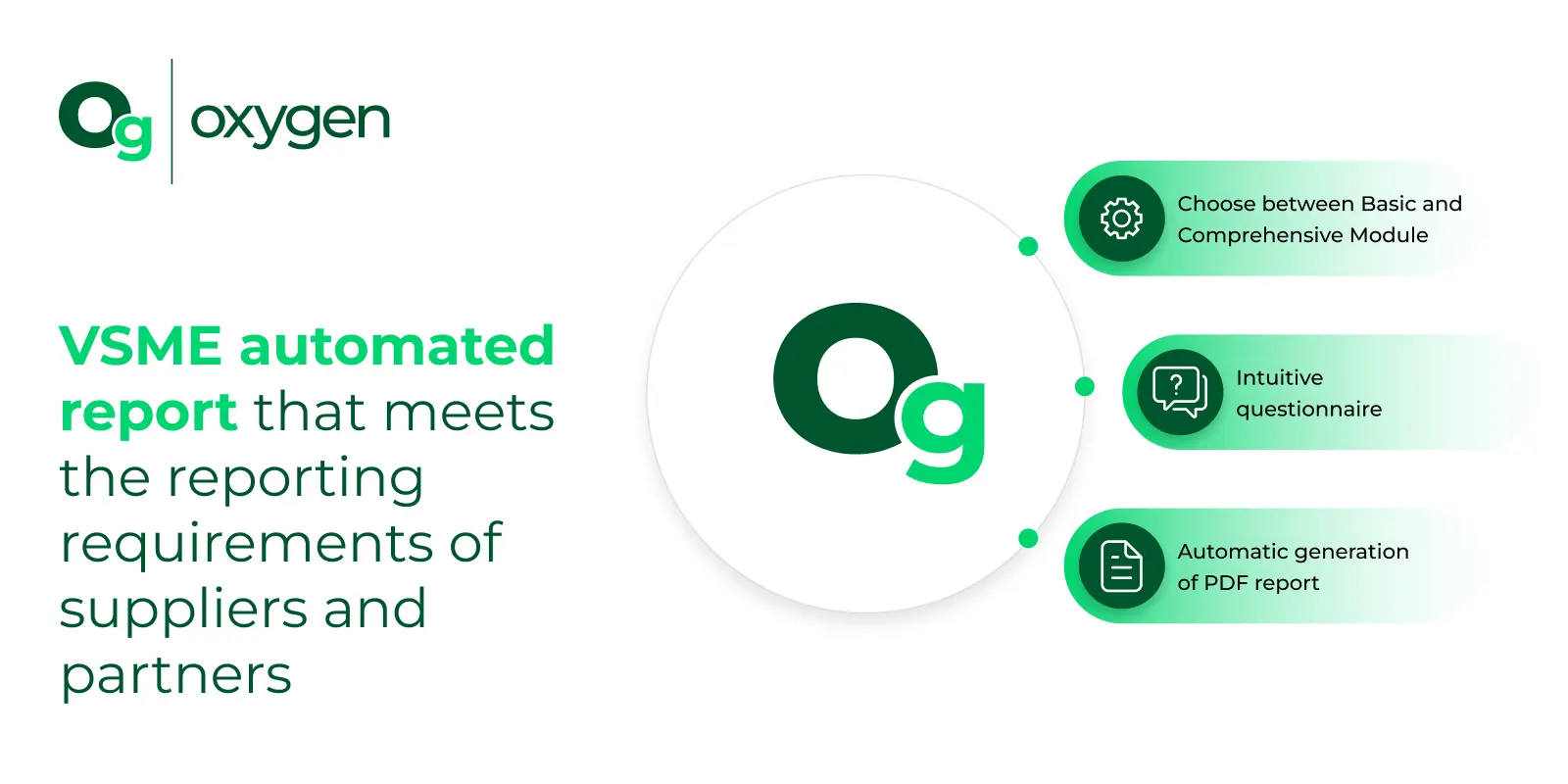
Oxygen's new functionality allows companies to quickly, intuitively, and effortlessly organize, structure, and share information in full compliance with the voluntary VSME standard. Oxygen offers both basic and comprehensive reporting modes, providing flexibility for organizations of all sizes. The bilingual environment ensures that materials are ready for international counterparties without the need for additional translations.
With just a few clicks, the completed information is converted into a professionally formatted PDF report, ready for presentation to banks, investors, customers, and regulators. Oxygen takes pride in offering significant time savings, less administrative burden, and structured, visually organized, and convincing documentation of the company's sustainability.
Conclusion
The European Commission's recommendation on voluntary sustainability reporting for SMEs is a significant step towards simplifying the reporting process and supporting smaller companies in meeting market demands. With tools like Oxygen, SMEs can efficiently manage their sustainability reporting, ensuring compliance and enhancing their credibility with stakeholders.